Showing posts with label urban. Show all posts

Wednesday, February 15, 2017

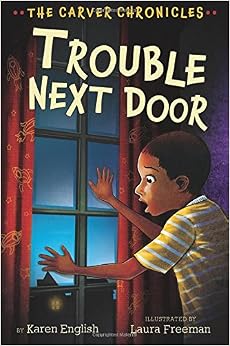
Trouble Next Door by Karen English

Image result for carver chronicles trouble nextTrouble Next Door by Karen English is an installment in a great little series called The Carver Chronicles. The characters are for the most part people of color but the setting isn't necessarily urban. The series is set in Carver Elementary school in

In this book,we meet an ordinary kid who sometimes has trouble doing his homework and who is having even more trouble thinking of a great idea for the science fair (something he desperately wants to win). At school he sometimes has to evade a big, gruff kid everyone calls Monster Boy. Then one day Calvin gets a new neighbor-Monster Boy!

Calvin must decide whether or not to accept Monster Boy as his friend as his dad wants him to or to completely ignore him despite the fact that they're neighbors. His friends would recommend the latter option.  Doing so would go against everything his parents taught him and besides...it's hard to avoid him when their bedroom windows face each other!


This book covers a lot of subjects (such as different families, bullies, science among others) but in a nice understated manner that is just right for  kids in grades 3 and up. I reckon it has some hi-lo potential as well. Highly recommended and I am going to check out the rest of the series as soon as I get a chance. Some read alikes are The Buried Bones Mystery by Sharon M. Draper, Nikki & Deja by Karen English and Sally Warner's EllRay Jakes series.

Wednesday, February 1, 2017

The Great Shelby Holmes by Elizabeth Eulberg

Image result    I don't judge books by their covers but this book by Elizabeth Eulberg not only has two children of different ethnicity but the title is also a nod the Sir Arthur Conan Doyle's Sherlock Holmes.  John Watson is new to the great metropolis and just as he and his mother are settling in to their new digs on Baker Street he meets a quirky kid called Shelby Holmes.

 Shelby is a preternaturally gifted child and she spends her time solving various petty crimes in the neighborhood, something which has made her somewhat of a celebrity.  Watson is amazed at the way grown ups treat her. Most grown ups that is, except police officer Lestrade...

 Mixing themes such as non-traditional families, current events, urban decay and so forth. Eulberg captures the atmosphere of the city of New York. There are various other nods to the great detective throughout the book that I won't reveal, I will say though that they add to the story and provide a good chuckle for Holmes fans.

    Holmes is awkward to say the least but Watson has his own health challenges and I liked that Eulberg incorporated that into the story as well. In the end this is a book that a variety of kids can relate to because these are not perfect kids. Some read alikes to it would be Sharon M. Draper's The Buried Bones Mystery, The Harlem Charade by Natasha Tarpley and Elise Broach's The Wolf Keepers.


Monday, May 16, 2016

The Hero Two Doors Down by Sharon Robinson


Hero-Two-Doors-Down.jpg (1000×1511)

This book is written by Robinson's daughter Sharon and is loosely based on a family friend's experiences with Jackie and his wife in Brooklyn, New York during the time when Jackie played for the Brooklyn Dodgers. Told as one long flashback it recounts a year in a young Jewish boy called Steven's life when Jackie's family moved into the neighborhood.

At first there is some opposition to the Robinson family from the current residents, all of whom are Jewish. Steven is surprised when his best friend, a girl called Sena expresses some doubts as well. Thankfully his family, and his father in particular are reasonable adults and are determined not to see the lessons of history repeated.

For Steven however, getting to meet Jackie is perhaps the highlight of his life and their families quickly form a strong friendship and celebrate holidays together another way in which they end up sharing their own unique cultural celebrations.


Recent events in our country have shown that there is still a lot of prejudice and ignorance to combat and that if left unchecked there are people with nefarious intentions who will try to enact legislation to discriminate against any group they dislike. Hopefully through reading books such as this one young kids will see that discrimination in any form is wrong and that when faced with it the right thing to do is to stand up against it. I recommend this book for kids 8+.

Monday, April 18, 2016

Liccle Bit by Alex Wheatle

Growing up as a fourteen year old is hard in any country. There are hormones, peer pressure and of course schoolwork to deal with. For Lemar his height is also a major disadvantage and he is sometimes called many nicknames (none of them complimentary) but the worst of them all is Liccle Bit ("liccle" being the Jamaican patois from of "little").

As if he didn't have enough problems, Lemar's older sister Elaine has just had a baby with Manjaro the baddest gangster around much to his parents' chagrin. Even though Lemar knows he shouldn't associate with Manjaro (his friends and family repeatedly warn him) he doesn't have the courage to say no when Manjaro asks him for a favor. That's when the trouble starts.

Wheatle's prose is razor sharp and Lemar's descriptions of his estate (known as housing projects here in the US) convey all the dreariness and hopelessness the residents feel. Lemar's friends to me served as both comedic foils and the differing sides of his conscience as they gave him advice on everything from family matters to matters of the heart.

I am going to be making many interlibrary loan requests for Wheatle's books (he's been writing for some time now) as they are a great perspective on  life outside North America and particularly on life for young people of color in London. I recommend this book for tween and teen readers worldwide as it shows how the power to choose rests within every individual.

Tuesday, March 22, 2016

The Boy in the Black Suit by Jason Reynolds


51idL1UzzRL._SX329_BO1,204,203,200_.jpg (331×499)

One thing that is certain about life is that we will lose loved ones. However despite this fact when we do lose someone there is always a mourning period of some sort. This is the premise of this great novel for young adults written by Jason Reynolds.

We meet a young man called Matt grieving after the loss of his mom. Matt was an only child and was very close to his mom so of course he takes her loss very hard. His dad, grieving himself doesn't quite know how to communicate with Matt. Then Matt gets a job at a local funeral parlor and finds that wearing the black suit is comforting...so he begins to wear it all the time.


Though he is grieving, Matt never really lets it out and continues life as usual, going through the motions more than anything else and hanging out with his best friend Chris. Matt does develops a strange obsession though, at the funerals he attends he starts searching out the faces to find the one person who is really, truly sad. This is comforting for him and he develops an eerie sense of who this person is. Then at one funeral he meets someone who will change his life and help him to deal.

Reynolds takes a tough subject but adds enough humorous touches here and there so as to not make the book totally depressing. In fact as we read the book we discover people who are grieving for many things and who have never really gotten over their grief but who make an effort day after day. This, I think is an excellent lesson indeed. I highly recommend this book.

Monday, October 19, 2015

All-American Boys by Jason Reynolds and Brendan Kelly


Recent events in our country have shown that despite the election of the country's first African-American President, the spectre of race still has not disappeared. The police are an important and necessary public institution but perhaps some of the methods used to police poor and minority communities need to be reexamined. One wonders also how many instances of police brutality would go unpunished if there were no such thing as camera phones. It is no wonder that police departments nationwide are adopting body cameras.

 All-American Boys is co-written by two authors, one African-American, one White and I think this lends some authenticity to the narrative. Cover images are so very important in attracting readers and this book does a good job in that regard with the novel's title in red and blue and a young man standing with his hands raised.

Told from two viewpoints, the young African-American youth Rashad is for all intents and purposes an All-American teen. He is active in sports, is gregarious and is enrolled in ROTC. His dad was both a former soldier and police officer and firmly believes in both institutions. The young white teen Quinn could also be described as an All-American kid as he also plays sports (on the same team as Rashad), is a dutiful older brother to his pesky brother Will and is a good son to his widowed mom.  Those similarities are the only things they have in common however.

In many senses this is a coming of age story because Rashad is forever changed (physically and mentally) and Quinn's relationship with his own friends and with Rashad is altered dramatically. The authors give a very accurate portrayal of the inner torment both characters experience as they begin to change their world view and alter their beliefs.

Some of the language and situations described are a tad graphic and for this reason I would recommend this novel for ages 13+. Some read alikes are How it Went Down by Kekla Magoon and Tyrell by Coe Booth. One quote from the novel resonated very deeply with me "If you are neutral in times of injustice, you have chosen the side of the oppressor." Very true indeed.

Monday, October 5, 2015

The Seventh Most Important Thing by Shelley Pearsall


Book JacketHistorical fiction reads for younger reads aren't always the most popular or entertaining reads I must admit. I can't remember the last time a young customer has requested one of them in the library. However, when one does find a book that is not only based on historical events but is also a transcendent story then it must be lauded. Shelley Pearsall's The Seventh Most Important Thing is one such book.

Set in a grittier part of Washington DC we meet young Arthur T. Owens just after he threw a brick at a man known as Young Man. Arthur's life changes after this not only because he has to work for the Junk Man (collecting various materials) but also because he has to report to a no nonsense probation officer called Officer Billie. Arthur's life at school changes as well when he befriends a strange kid called Squeak. True to his name, Squeak is small, mouse-like in his demeanor but he also proves to be a loyal and devoted companion.

The central theme of the book however is Arthur's relationship with the Junk Man. The latter harbors no ill will toward Arthur and instead is glad for assistance with his project which is complex in its execution and grand in its scope. Arthur's view of the world will never be the same after his experience with the Junk Man.

I recommend this book for ages 10+ due to some language and the content. It is a well-written book and one that made me feel very positive after reading it. I say this because there was no superhero or deus ex machina to save the day. Instead, introspection, personal growth and accountability were the powers used to solve problems.

Some read likes for this book are The Paper Cowboy by Susan Levine, Jeremy Fink and the Meaning of Life by Wendy Mass and Kizzy Ann Stamps by Jerry Hanel Watts.


Friday, June 12, 2015

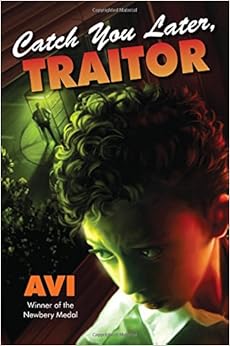
Catch You Later, Traitor by Avi

There was a time in American history when the specter of Communism loomed large in the national consciousness and the FBI was tasked with determining whom among us held views that went against the American Way. Agents used a variety of methods to help in this quest.

The main character in the novel Catch you Later, Traitor is a kid called Pete who lives a regular life in New York City but things change drastically when his teacher accuses him of having a Communist father. Pete, a fan of detective radio shows and comic books, begin to use his budding detective skills to prove that his dad is no Communist. What he discovers however are some secrets that will forever change him.

Avi  uses elements from his childhood growing up in the time of the Cold War and it is amazing how much things have changed but still remain the same. Some of the food Pete encounters are new to him but are ubiquitous now. Pizza for example is a huge treat for him back then whereas people eat it literally for all three meals.

This novel explores various themes as well, among them family, marriage, friendship. Avi uses a light touch however so the reader does not get bogged down with the details. Pete does not have the closest relationship with his older brother Bobby and their encounters are usually short and terse. Pete is very close to his father however and their bond is strengthened through the trying circumstances in which they find themselves. Pete has also placed various extended family members in neatly defined categories but this changes as the plot unfolds.

Friendship is a major part of the story also and Pete finds his friendship with his best friend, a girl called Kat, sorely tested. In the climate of the day friends who were loyal were hard to come by since there were many government agents bent on rooting out anyone with suspected Communist ties.

Avi lives here in Denver and even checks out books from a branch of my library system (how cool is that!). I am ashamed to say that this is the first of his books that I have read but it will not be the last. I recommend it for ages 9+.

Saturday, May 30, 2015

Ferals by John Grey


Caw is a young boy who was abandoned by his parents who he assumes are dead. He has been taken in by three crows, the aptly named Glum, young upstart Screech and old, stoic Milky, a white crow who is blind. Caw can communicate with the crows in a language only they understand and their relation is mutually beneficial in that they help him keep out of trouble and he helps them scavenge dumpsters and other places for food.
Caw is content to continue with this peripatetic existence until one night he witnesses a jailbreak by three sinister individuals. This leads him into contact with a headstrong girl called Lydia whose father is the prison warden.  It soon becomes apparent however that the three escapees are not regular people- they have the power to control animals. Caw and Lydia begin to seek help to find out more information about the trio and this leads them to a sympathetic librarian, another street dweller among others.


As they learn more about the sinister trio they discover that there is a fiendish plot underway and that those events are connected to the disappearance of Caw's parents. They also learn that Caw himself has some supernatural powers when it comes to animals but he will have to learn how to control it. More importantly Caw has lived most of his life on the fringes of human society so he will have to learn to collaborate with humans.

There are some truly touching moments in this book where matters of class and belonging are explored. My heart went out to poor Caw when he visited Lydia and displayed absolutely no social grace. The librarian proved to be a very helpful character and showed that librarians in modern society are very different from the shushing, reserved characters that come to mind when one thinks of librarian. Caw's interactions with the crows was entertaining as well. Screech is aptly named and has some very funny lines.

Although the end was a bit strange I had to remind myself that this was after all a fiction novel. Caw is only thirteen years but yet survives on the street without anyone realizing. This brought to mind the increasing problem of homelessness in America's suburbs. Grey did a fantastic job of portraying a dark, foreboding city but the book is not too menacing for young readers. I recommend this book for ages 10+.


Monday, March 2, 2015

Hold Tight, Don't Let Go by Laura Rose Wagner


Many of the teen books I see feature kids with what are affectionately known as "first world problems" i.e. who to go to the prom with, what clothes to wear etc. This is not to belittle those issues but I am sure even the protagonists of those books would admit how good they have it. Hold Tight Don't Let Go features two girls Magdalie and Nadine who have been  brought up like sisters in Port-au-Prince, Haiti. After a terrible earthquake they are forced to live in a refugee camp where conditions are squalid to say the least.

The girls make do and learn to enjoy their new life in the much changed capital city. They are normal teenagers with normal teenage angst and experiences. The novel has many American pop culture references which make the text accessible to the North American reader (and also show how prevalent American culture is worldwide).

Life changes for both girls when Nadine gets an American visa and moves away to Florida. She promises to do the same for Magdalie and this hope of making the trip to America becomes the only thing that sustains her. I would also add that obtaining an American visa is one of the most important things in the lives of millions of people worldwide and small industries are devoted towards securing that or a green card. The US despite its flaws is still seen as a land of milk and honey and exceptional opportunity.

There are countless novels featuring a female protagonist who, at her wits end decides to use her body as a commodity. I was very glad that she did not choose that route nor that of the easy life offered to her by another character later on in the book. The author Wagner as an educated woman and anthropologist must have been very conscious about her portrayal of the country's citizens.

Nadine does not live a charmed life in Miami however and in her few conversations she has with Magdalie seems conflicted about her new life and seems to be experiencing a small degree of culture shock. Magdalie also experiences a shock of her own when she travels to the remote village her mother is from. Wagner does well to portray a reality on Haiti (and many of the Caribbean nations for that matter), that of the ease of country life but its stifling quality and lack of amenities.

I was pleased to see that in the afterword Wagner gave a brief explanation as to why Haiti is the way it is. It is common to hear that Haiti is the the poorest country in the hemisphere etc but most people don't bother to read up on exactly why that is. This is a good book for a young reader because of the universal themes explored but also because it gives an unflinching portrait of the soaring heights and dreadful depths that is Haiti.


Sunday, March 1, 2015

Bad Boy by Walter Dean Myers


Myers was a literary giant and extremely prolific author who wrote boks in a variety of genres. He wrote some books that dealt with inner city life and you felt that he knew what he was talking about, that he had lived that experience. In this autobiographical book he talks about his life in an accessible way. A young reader can empathize with some of the themes he discusses despite the fact that Myers is a child of the post World War II era. We learn some interesting facts about young Walter in this book, such as why he uses all three for example.

Myers recounts his academic prowess and subsequent realization that such behavior was deemed masculine. A telling line in the book is when he describes having to carry books home in a bag so that the neighborhood boys would not tease him or worse. Another aspect of the book that young readers may empathize with is his awkwardness around girls, he does not talk about a girlfriend or serious relationship.

Though Myers does not go into detail about segregation and the unfortunate treatment of non whites during that era, he describes his best friend Eric *a white boy) with whom he gets along really well. As the boys grew older,  there are places that Eric can go where young Walter was unwelcome, a difficult realization for him.

His parents wanted to see him succeed in school and Myers realized early on that education was the only way for him to not have a tough time as his parents did. His father could not read and was proud of his son's accomplishments but one gets the sense that he was somewhat unsure of how to feel. It is Myers' mom who seemed to be his true champion as she is the one who intervenes when Myers interest in school began to wane.

Overall this is a good read with the compelling writing which we are used to seeing in Myers' books. It is not a stirring book however when compared to other coming-of-age novels by other African American writers. I do however recommend it for readers aged 11+.

Sunday, February 22, 2015

Beneath by Roland Smith


I have traveled on many subways and trains across this country and whenever I  caught glimpses of tunnels as the train whizzed by I couldn't help but wonder about life in that subterranean maze. There are people who frequent the nether regions beneath our society but to have an actual functioning society down there is something that is hard to imagine...or is it?

Young Pat loves his older brother Coop despite the latter's quirky nature. The boys come from a loving if slightly weird family with two extremely smart parents who are good at their jobs but not so great at raising kids. Then one day his brother disappears and then Pat begins receiving some strange communiques from him. This leads him to New York city where the mystery deepens.

Pat finds not one but two societies underground with a hierarchy, strict laws and  some strange characters. It is his luck that he enters that world at a time of upheaval and although he makes alliances he doesn't know who to trust. There are some dangerous people in the world below, and some of them may be a threat to the world above ground.

Smith does a good job of showing how Pat begins to act like a person from down below after just a short time. While I must admit that Coop seemed just a bit too reckless for my liking he was a good foil and without his shenanigans we would have no story.

I like this book since not only does it show a young protagonist who must be brave in the face of terrible adversity, but he also must conquer some very real phobias that have dogged him his entire life. There are multiple literary references as well and the author is obviously an avid reader. I recommend this book for readers aged 10+


Tuesday, February 10, 2015

Ghetto Cowboy by G Neri

There are few books that can combine cowboys, family drama, inner city life and still have an authentic feel. In Ghetto Cowboys, we meet Cole, a troubled boy who lives with his mother in Detroit. His shenanigans have pushed his mother to the edge and she decides to carry him to Philadelphia to live with his father, Harp, a man she has never spoken about and whom Cole has never met. Harp is not exactly pleased to see his son and for various reasons, chief among them that he lives with horses. After Cole gets over the initial shock, he is able to live with the beasts; the bigger question is if he will be able to live with his father.

This is a timely book for many reasons. First urban decay is rampant in many cities across America bringing with it various societal ills. Communities of color have been disproportionately affected by economic downturns with staggering consequences. Although there are various social groups, fraternities and clubs that do their part to help mentor the youth in their community, these groups are rarely highlighted in the media.

What's more, the book drops tidbits here and there about the history of the word "cowboy", famous African American cowboys, the long history of African Americans racing thoroughbreds as well as the inner city practice of keeping horses. Neri is careful not to overload the reader with that info however but instead reveals nuggets of information in small doses.

 Another aspect of the story that I liked was the respect for tradition. The Cowboy Way is mentioned several times as a way of living an honorable life. Among the supporting characters I liked the old timer Texas Pete. He was well respected and treated in a very reverential manner. This respect for older generations is something that has diminished somewhat in recent years. I am glad that Neri included that character and made him worthy of respect instead of a crazy old coot.

There is a picture in the back of the book of a real life inner city boy with his beloved horse. Neri in his afterword mentions the Federation of Horsemen in Brooklyn, I had never heard about such an initiative before despite having visited the borough on many occasions. The illustrations, done by JJ Watson add another layer to the story. We see Harp's emotions. Exhilaration, disappointment, worry.  Cole (short for Coletrane) also runs the gamut of emotions: fear, trepidation, excitement.  The illustrations are also good for low readers as they help make sense of the text. I highly recommend this book for kids aged 10+

Tuesday, November 11, 2014

How It Went Down by Kekla Magoon


Sometimes when an incident occurs eyewitnesses have a different take on what exactly occurred. What they see is often colored by their experiences and prejudices. That is the case in Kekla Magoon's fantastic book for teens called How It Went Down which deals with the fall out from the killing of an unarmed black teenager called Tariq by a man named Jack Franklin. As (bad) luck would have it Franklin just happens to be white.

The premise appears ripped from the headlines what with the recent unrest in Florida and in Ferguson, Missouri. One of the better drawn characters is the preacher Pastor Sloan who is conflicted with his role. On one hand he is scoring political points which help bolster his campaign for office, on the other hand he has a son of his own with whom he does not have the best relationship. the Pastor also has to resist the temptations that come with his standing.

Written in small first person vignettes that slowly reveal the characters' relationship if any with the victim, Magloon paints a picture of a neighborhood trying its best to deal with the aftermath of the youth's killing.  This killing is especially hurtful because while Tariq was no angel his death was completely unavoidable. The killing reverberates in several other ways too and causes the beautiful Jennica to examine her relationship with gang member Noodle. At first she is aghast at his callous reaction to the Tariq's death but gradually she begins to examine her life and what she wants out of it.

Tariq was flirting with joining a gang and the gang's leader Brick feels that he was closer to joining than he really was. Through the eyes of the youngest member of the group, Tyrell we see how he Tariq, Sammy, Junior and youth were close knit but drifted apart as the call of the streets became too strong.  Junior is in jail serving a long sentence for a crime that he took the rap for. Sammy is afull-fledged member of the group and is determined to climb the ranks.

The role of fathers is underscored and by far the most fatherly figure is Steve Conners who seems to care more about his step son than Tyrell's own biological dad. To say the two enjoy a frosty relationship putting it mildly. Tyrell is academically gifted and is determined to go to college and become the first one in his circle and his family to do so. Though it is not overtly stated it seems that his father feels threatened by his son's upward mobility. Besides the father-son dynamic there is also a class divide apparent. Steve implores Will not to return to the hood and his disdain towards the denizens of that part of town is apparent.

This is a fantastic read that rings to light many societal ills and many issues within the African-American community. It is telling that the older African American males who are in a position of power and influence make no attempt to mentor or provide some sort of guidance for these at-risk youth. Also Pastor Sloan himself admits that were the shooter another young black male he most likely would not have been as visible and as vocal in the press and on tv.  This is a timely read and while it does not delve deeply into issues that need to be addressed, it at least starts a discussion.


Friday, October 17, 2014

Stupid by Kim Firmston


 For a father to call his son "stupid" constantly is perhaps the worst thing imaginable but this is the word Martin's dad constantly uses to describe his son. Martin is sixteen and is not exactly an A student. It bothers him that his younger sister Carly makes good grades and is the apple of his dad's eye. Besides his struggles in school, Martin isn't good at sports either which is one less thing his dad can brag about. What he is good at is filming and it is on one nighttime filming shoot at an abandoned brewing company that he meets Stick, a parkour enthusiast. The pair quickly bond and Martin tells stick that he can film he and his friends doing parkour.  Stick encourages Martin to enter the film into a contest to which the latter reluctantly agrees.

   Martin's academic woes at school continue which leads to frequent fiery encounters with his dad who doesn't seem to be the most patient individual. His dad is a frequent Googler and then acts on whatever the search results turn up. This is why poor Martin has a ton of Ritalin which he doesn't take. The story is written from Martin's point of view so we see how he describes his study routine and we share his disappointment when after all the effort he expends his grades still don't go up. After one particularly fiery argument with his dad he tries to confide in Stick but Stick's reaction is not what he expected and Martin learns that Stick does not exactly come from a nuclear family.
 
Stick proves to be a good influence on Martin though and it is he who helps Martin develop a plan for dealing with his academic woes. Martin begins equating life struggles with parkour obstacles and developing strategies to overcome them. I like that the book talked about issues both social and personal. Martin as it turned out had a problem that could be easily detected and fixed. From the various descriptions in the story I guessed what the problem was and I was a bit ticked off in the end because no one around Martin detected it earlier. (I suspect that in real life this may not have happened but it served as an effective plot device in this book). There is some inappropriate language used so I would recommend this book for ages 14+.

Tuesday, October 14, 2014

Kinda Like Brothers by Coe Booth

      I rarely see juvenile fiction booths with young African-American males on the cover so needless to say I was intrigued by this title. The main character Jarrett is a rising seventh grader from Newark, New Jersey who lives with his mom, a Guyanese immigrant. His mom is a foster mom who works with social services to take n kids for varying lengths of time. This is how Kevon and his little sister Treasure come into their lives. Kevon's father went missing and so the two are placed with Jarrett's family for the time being.
     Jarrett is not pleased with this arrangement since Kevon has to share his bunk bed and his living space. Kevon also ends up going to the rec center with Jarrett since it is summer time and there is a lot going on there. Jarrett is also dealing with some health issues as well as some academic difficulties (he has to go to summer school for remedial help). He is a budding Romeo as well even though he can't muster up the courage to tell his friend Caprice that he likes her.  The boys are two headstrong characters so it doesn't take long for them to butt heads over various issues.


    Even though the book is set in Newark it isn't necessarily about the harsh reality of urban life, at least not for Jarrett. He and his mom live a relatively comfortable life and he is exposed to a lot more things than Kevon (at one point in the book Kevon mentions never having tried tacos). The book explores a bunch of issues some more in depth than others. Jarrett learns for example that his best friend is gay but he is ok with this. There are issues about mental health, coping with grief and anger, as well as proper conduct as an African-American male when stopped by the police.  The author also introduces elements of Caribbean culture and briefly mentions the generational and cultural differences that exist between Caribbean immigrants and their offspring who are often more finely attuned to the nuances of American culture.
    One would think that all these issues would bog the book down but Booth skillfully weaves short but powerful vignettes into the narrative. Perhaps more importantly for me was the role of positive male  role models for the next generation of African-American youth I especially liked the fact that she made a passing reference in the book to stepping and the role of such in the black community.

This is an excellent read and I recommend it for readers aged 11+. Even though the main characters are of color the issues are universal and timely. There is no happy ending to this story and we know that both boys will eventually argue about one issue or the other the beauty lies in the fact that they can admit their wrongs and move on peacefully- a good life lesson. I am looking forward to more reads from this author.

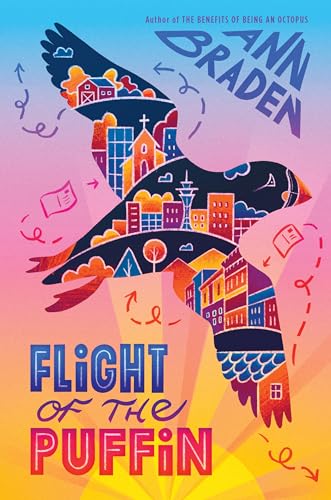
Flight of the Puffin by Ann Braden

 Middle school is such a weird time. As an educator, I witness firsthand every year how friendships change or are dropped, how kiddos start ...